Not beer. Not whisky. Let’s talk about sake — properly.
Tourists who come to Tokyo drink sake. Of course they do. But what they’re actually ordering is whatever says “sake” on the izakaya menu, or the bottle they grabbed at duty-free because the label looked cool.
Ten years ago, that was me too.
Let me start with my younger self.
There’s a pretty standard drinking progression for young people in Japan. It goes like this: beer first, then chuhai — those sweet, fizzy RTD drinks that taste like juice. Then, once you’re bored of both, you reach for the sake on the izakaya menu.
And that’s where a lot of people get burned.
The cheap sake at most izakayas is, to put it plainly, not good. It’s loaded with distilled alcohol and additives, and it has a particular talent for giving you a splitting headache the next morning. There’s a reason so many Japanese people say “I don’t really drink sake” — they tried it once at a bar in their twenties and never went back. I was one of them. To my younger self, sake was the drink of tired salarymen and bad decisions.
That changed ten years ago.
It started with a colleague.
There was a guy at my company who was obsessed with sake — genuinely obsessed, the kind of person who makes it his personal mission to convert everyone around him. One day I told him honestly: “I don’t really like sake.”
He didn’t miss a beat.
“MASSAN, you need to try the real thing. It’ll change everything.”
“I’m not saying the stuff at the supermarket is bad. But what I call real sake — it’s made carefully, by hand, in small batches. That’s exactly why you never see it. It doesn’t make it into mass distribution. Most people never encounter it.”
I nodded along. But honestly? Part of me was still thinking: it’s still sake. How different can it be?
So I went to a brewery.
Around that time, I found out that a sake brewery near my neighborhood was offering tours. I signed up — mostly out of curiosity, with fairly low expectations.
Inside the brewery, one of the brewers explained it simply: “We do every step of this process with a small team. If you want to make sake carefully and well, you can’t make a lot of it.”
Looking around the brewery floor, I noticed something: almost no machines. Just people, working quietly, moving with the kind of unhurried focus you don’t see much anymore.
Then they poured me a glass.
The moment it hit my tongue, something shifted. A soft sweetness followed by layers of flavor I didn’t have words for. It sounds dramatic, but I genuinely felt it in my chest — like a small electric shock. Before I even knew I was speaking, I heard myself say:
“…This is sake?”
The brewers smiled. Not the polite, customer-service smile. The real one — the quiet satisfaction of someone who has just shown you something true.
That smile said everything.
One more thing I haven’t forgotten.
At the end of the tour, one of the brewers said something almost offhand: “We work hard and we make something we’re proud of — but honestly, the margins aren’t great.”
He laughed a little. But he wasn’t joking.
Then he said: “Still. This is something Japan can be genuinely proud of. I want people from all over the world to try proper sake and be amazed by it.”
That’s the sentence that stayed with me. And honestly, that’s why I’m writing this ten years later.
So what should you actually drink?
Don’t overthink it. Here’s a simple breakdown.
How rice polishing works
| Type | Reading | Polishing Ratio | Flavor Profile |
|---|---|---|---|
| Daiginjo | 大吟醸 | 50% or less | Fruity, floral, light and clean |
| Ginjo | 吟醸 | 60% or less | Balance of fruity notes and rice umami |
| Honjozo | 本醸造 | 70% or less | Crisp and dry. Works well warmed |
| Junmai | 純米 | No requirement | Rice and koji only. Rich, full-bodied umami |
| Futsushu | 普通酒 | No requirement | Everyday table sake. Most widely distributed |
Junmai combinations
| Type | Reading | Polishing Ratio | What makes it special |
|---|---|---|---|
| Junmai Daiginjo | 純米大吟醸 | 50% or less | Zero additives + maximum polish. Perfect as a gift |
| Junmai Ginjo | 純米吟醸 | 60% or less | Fruity + natural umami. The best entry point for beginners |
Pasteurization: fire in, fire out
| Type | Reading | Characteristics | Storage |
|---|---|---|---|
| Pasteurized (standard) | 火入れ | Stable flavor. Widely available | Room temp OK |
| Namazake | 生酒 | Raw, straight from the press. Fresh and lively | Refrigeration required |
| Namachozo | 生貯蔵酒 | Stored raw, pasteurized before shipping | Refrigeration required |
| Namazume | 生詰め酒 | Pasteurized after brewing, raw before shipping | Refrigeration required |
A quick note on polishing.
The lower the seimaibuai number, the more of the grain was milled away. At 50%, you’re throwing out half the rice before you even start brewing. It sounds wasteful. But that’s exactly what produces the clean, delicate sweetness in a daiginjo. Once you understand this, the price tag starts to make sense.
A quick note on pasteurization.
Most sake is heat-treated twice during production — this is called hi-ire, and it stabilizes the flavor and extends shelf life. But namazake skips this entirely. It goes straight from the press into the bottle, raw and alive. The difference in taste is immediate: fresher, livelier, almost electric. The catch is that it needs refrigeration and doesn’t last long. You won’t find it at a convenience store. You have to go somewhere that actually cares about sake.
Where to find it.
Convenience stores: forget it. Supermarkets: a few options, nothing special. But if you’re serious, look for two things: an independent liquor store, or a kakuuchi.
A kakuuchi is a standing bar built into a sake shop — you buy a glass or a bottle right at the counter and drink it on the spot. Tell the owner it’s your first time. They’ll put something seasonal in your hand without making you feel stupid about it. There’s at least one within walking distance of almost every major train station in Tokyo.
No reservation. No dress code. Five hundred yen, and you’re drinking something real.
🍶 MASSAN’s Sake Pick — Vol.1
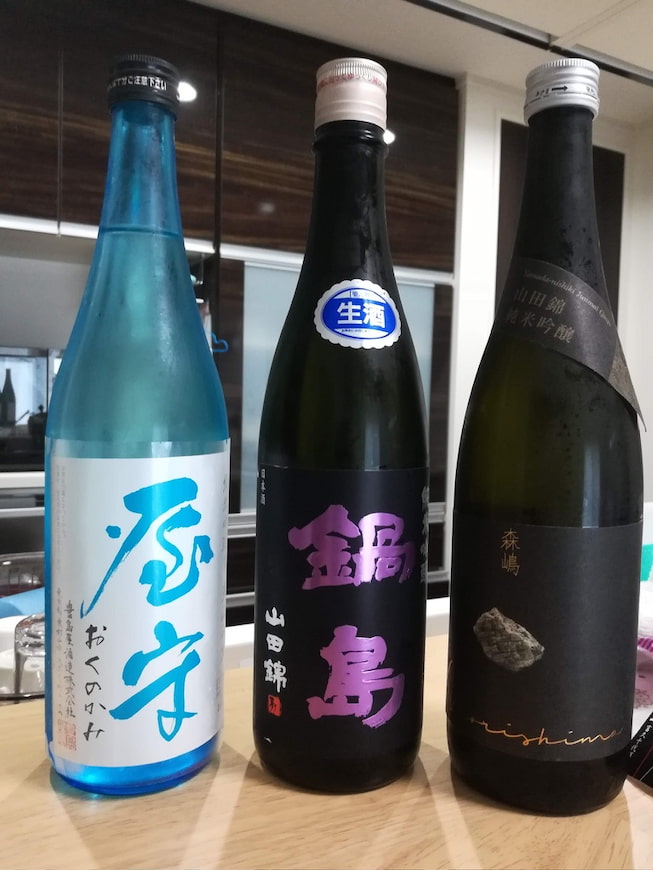
| Name | Nabeshima Yamadanishiki Namazake |
| Type | Namazake (Junmai Ginjo) |
| Brewery | Fukuchiyo Shuzo, Saga Prefecture |
| Where to find it | Independent liquor stores, kakuuchi, specialty sake shops |
| One line | The bottle that taught me what namazake actually means |
The three bottles in the photo above. Left to right: Okunokami, Nabeshima Yamadanishiki Namazake, Morishima Yamadanishiki Junmai Ginjo. All three are worth finding.
That brewer’s words have stayed with me for ten years: “I want people from all over the world to try this and be amazed.”
If you’re reading this from outside Japan — this is your invitation. The amazement is real. And it’s waiting at a tiny shop near a train station you’ve probably never heard of.


Comments